4 - numbers
1 through 19
You just have to memorize numbers 1 through 19:
| number | french |
|---|---|
| 1 | un |
| 2 | deux |
| 3 | trois |
| 4 | quattre |
| 5 | cinq |
| 6 | six |
| 7 | sept |
| 8 | huit |
| 9 | neuf |
| 10 | dix |
| 11 | onze |
| 12 | douze |
| 13 | treize |
| 14 | quatorze |
| 15 | quinze |
| 16 | seize |
| 17 | dix-sept |
| 18 | dix-huit |
| 19 | dix-neuf |
20 and 29
After that, you just have a general rule exactly like spanish, where the tens place has its own word, and then you just combine it with the ones digit number you already know. This familiar pattern is for numbers 20-69.
Here are the tens places:
| number | french |
|---|---|
| 20 | vingt |
| 30 | trente |
| 40 | quarante |
| 50 | cinquante |
| 60 | soixante |
For example, this is how you write 20 - 29:
| number | french |
|---|---|
| 20 | vingt |
| 21 | vingt et un |
| 22 | vingt-deux |
| 23 | vingt-trois |
| 24 | vingt-quattre |
| 25 | vingt-cinq |
| 26 | vingt-six |
| 27 | vingt-sept |
| 28 | vingt-huit |
| 29 | vingt-neuf |
This pattern continues for 30-69.
70 and 79
Instead of saying 70 as “septante”, france says it as “60 + 10”, or “soixante-dix”. Then if you want to say something like 71, you say it as “60 + 11”
| number | french |
|---|---|
| 70 | soixante-dix |
| 71 | soixante et onze |
| 72 | soixante-douze |
| 73 | soixante-treize |
| 74 | soixante-quatorze |
| 75 | soixante-quinze |
| 76 | soixante-seize |
| 77 | soixante-dix-sept |
| 78 | soixante-dix-huit |
| 79 | soixante-dix-neuf |
80 and 90
To say something like 80, instead of “octante”, you say “4 20s”, which makes for “quatre-vingts”:
-So, basically, the word for 80 is just “quatre-vingts”
| number | french |
|---|---|
| 80 | quatre-vingts |
| 81 | quatre-vingts-un |
| 82 | quatre-vingts-deux |
| 83 | quatre-vingts-trois |
| 84 | quatre-vingts-quatre |
| 85 | quatre-vingts-cinq |
| 86 | quatre-vingts-six |
| 87 | quatre-vingts-sept |
| 88 | quatre-vingts-huit |
| 89 | quatre-vingts-neuf |
Instead of “nonante”, saying 90 is basically just “80 + 10”, following the exact same pattern as 70. So 90 in french is “quatre-vingts-dix”
| number | french |
|---|---|
| 90 | quatre-vingts-dix |
| 91 | quatre-vingts-onze |
| 92 | quatre-vingts-douze |
| 93 | quatre-vingts-treize |
| 94 | quatre-vingts-quatorze |
| 95 | quatre-vingts-quinze |
| 96 | quatre-vingts-seize |
| 97 | quatre-vingts-dix-sept |
| 98 | quatre-vingts-dix-huit |
| 99 | quatre-vingts-dix-neuf |
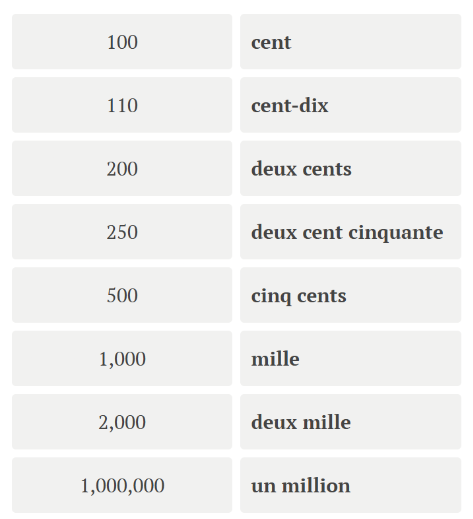
100 and up
Once you reach 100, you’re back to a familiar pattern which follows the exact same pattern as spanish.
Here are the next big units of numbers:
| number | french |
|---|---|
| 100 | cent |
| 1000 | mille |
| 1,000,000 | million |
You just combine them with other numbers, like two say 200, you just say “2” and then “100”, giving you “deux cent”